
From Clam Shells to Biodegradable Plant Pots: Student Project Wins First Prize
(DTO) Moving beyond textbook knowledge, many students in Dong Thap have channeled their passion for technology into practical solutions for everyday life. A notable example is a project to manufacture biodegradable plant pots from clam shells by two students at Sa Dec High School, which clinched First Prize at the 19th Dong Thap Provincial Youth and Children’s Creativity Contest in 2026.
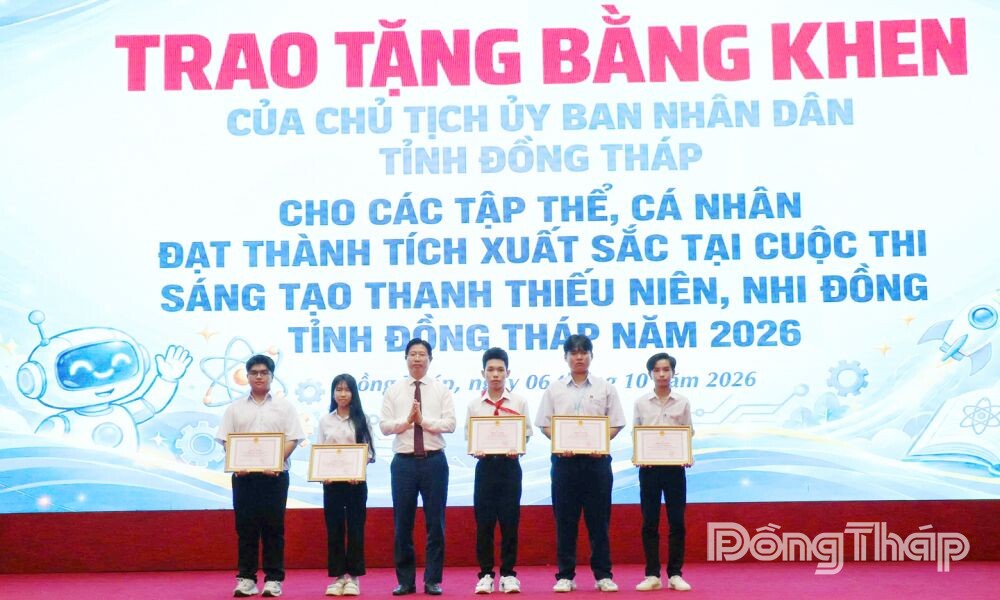
The project was developed by Nguyen Minh Triet and Nguyen Si Nguyen, both Grade 11A3 students at Sa Dec High School. Seeking to effectively valorize agricultural and aquaculture waste streams, the two began harboring their idea in 2025 and gradually turned it into a concrete project.
Dong Thap is renowned for its thriving ornamental flower and plant industry, as well as traditional craft villages specializing in rice flour production, clam harvesting, and rice husk milling.
However, through field surveys, the students found that production activities still pose considerable environmental challenges. In the ornamental plant sector, plastic pots are widely used because they are inexpensive and convenient. After prolonged use, however, they often degrade, are difficult to recycle, and end up as persistent plastic waste, intensifying environmental pressures.
This situation highlights the urgent need to reduce plastic waste while repurposing local by-products, in line with the development of a circular economy.
The students’ solution was to produce biodegradable plant pots from clam shells combined with agricultural by-products, offering an alternative to conventional plastic pots. Turning the idea into a finished product, however, was far from straightforward.
Initial prototypes failed to meet the required standards for physicomechanical properties, load-bearing capacity, bending flexibility, and biodegradability. The team therefore conducted repeated experiments to identify the optimal mixing ratio and adjust the clam-shell particle size.
One particular challenge was that the blending process had to be executed simultaneously with heating. After several unsuccessful attempts, the students found a suitable device: a plant-based milk maker capable of both grinding ingredients and heating them.
They also refined the order in which ingredients were mixed, controlled the temperature during starch gelatinization, and optimized the dispersion of clam-shell powder throughout the biopolymer matrix.
These improvements produced a more uniform material, minimized agglomeration, increased pot durability, and enhanced biodegradability—laying the groundwork for potential expansion to larger-scale production.
Under the team’s optimized process, clam shells are first washed, soaked in a 10% sodium hydroxide (NaOH) solution for four hours, dried, ground, and passed through a 200-mesh sieve to obtain fine powder.
The powder is then mixed with starches (rice flour and cassava starch), along with chitosan, glycerol, water, and edible vinegar. The mixture is heated and stirred continuously to remove air bubbles. Alginate powder is added at the final stage before the mixture is poured into molds.
Using raw materials such as clam shells and flour residue combined with agricultural by-products, the students have created a product with high utility value.
The biodegradable pots are designed to be safe and environmentally friendly. They can also provide plants with slow-release nutrients, protect their root systems, and support stable growth.
The project pursues three main objectives: reducing carbon emissions associated with extracting calcium carbonate from non-renewable limestone deposits; upcycling agricultural by-products to reduce waste; and promoting a circular economic model as part of the transition toward a green and sustainable economy.
Building on their achievements, Minh Triet and Si Nguyen are continuing to expand the project by developing a wider range of bioplastic products, including desk organizers, bookshelves, and decorative home furnishings. These efforts aim to further demonstrate the material’s practical applications and commercial potential.
Reflecting on their achievements, the two students said: “For us, these accomplishments are not the ultimate destination but motivation to continue developing and improving bioplastic products in a more sustainable direction, while researching and expanding the range of environmentally friendly material solutions.”
In addition to winning First Prize at the 19th Dong Thap Provincial Youth and Children’s Creativity Contest in 2026, the project also won First Prize at the first Dong Thap Provincial Science and Engineering Fair in 2026 and Fourth Prize at the 13th National Science and Engineering Fair for the 2025–2026 academic year.
By TUAN LAM – NGOC PHUONG
Translated by X.QUANG